





The cryptocurrency industry has grown beyond simply sending and receiving digital money. Today, blockchain networks support decentralised finance (DeFi), digital assets, NFTs, gaming applications, token exchanges and many other services. Among the networks designed to support these activities, Solana has attracted attention for its focus on high transaction throughput, relatively low fees and developer-friendly infrastructure.
Solana is a Layer-1 blockchain that allows users to transfer digital assets and interact with decentralised applications without depending on a central authority. Its architecture combines Proof of Stake (PoS) with a cryptographic timing mechanism called Proof of History (PoH). Together, these technologies help validators coordinate transaction processing and maintain the network’s shared ledger.
But how does the Solana blockchain actually work? What happens when someone sends SOL, swaps a token or uses a decentralised application?
This guide explains the technology behind Solana, how transactions are processed, the role of validators and SOL, and the advantages and limitations beginners should understand.
1. What Is the Solana Blockchain?
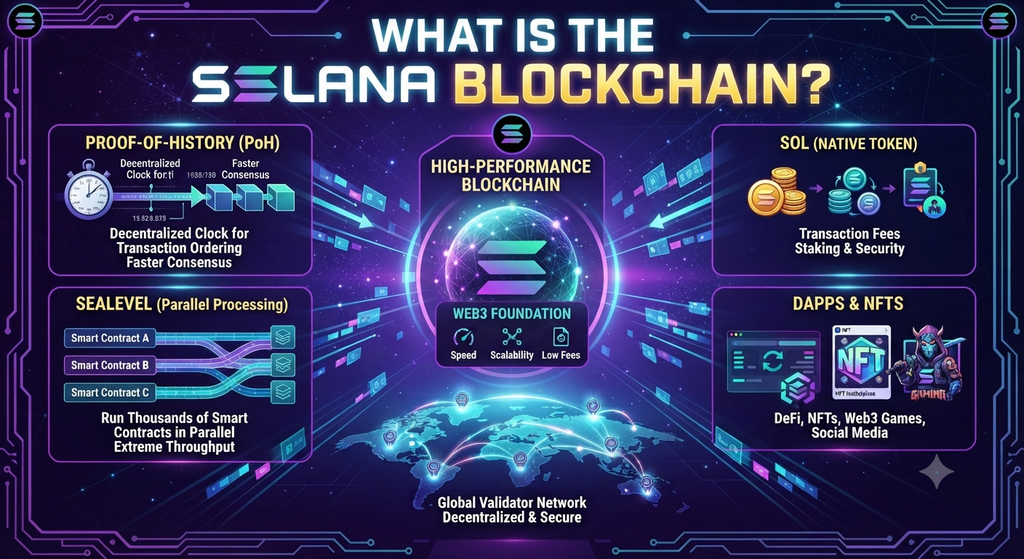
Solana is a public, open-source blockchain network designed to support digital payments, smart contracts, tokens and decentralised applications. It operates through a distributed network of computers called nodes rather than relying on one central server.
Like other blockchains, Solana maintains a shared record of transactions. Network participants can independently verify activity recorded on the ledger, helping maintain transparency and prevent the same digital assets from being spent more than once.
Solana’s native cryptocurrency is SOL. It is used to pay transaction fees, participate in staking and interact with applications built on the network.
Some important characteristics of Solana include:
- Layer-1 architecture: Solana operates as an independent blockchain rather than requiring another blockchain to process its transactions.
- Proof of Stake: Validators participate in network consensus through a staking-based system.
- Proof of History: A cryptographic mechanism helps establish the order and passage of time between events.
- Smart contracts: Developers can deploy on-chain programs that perform predefined operations.
- Digital assets: The network supports fungible tokens and non-fungible tokens.
- Low transaction costs: Its design aims to make routine blockchain activity affordable, although actual fees and application costs can vary.
Solana is used for token transfers, decentralised exchanges, lending platforms, NFT marketplaces, blockchain games and other applications.
2. How Does the Solana Blockchain Work?
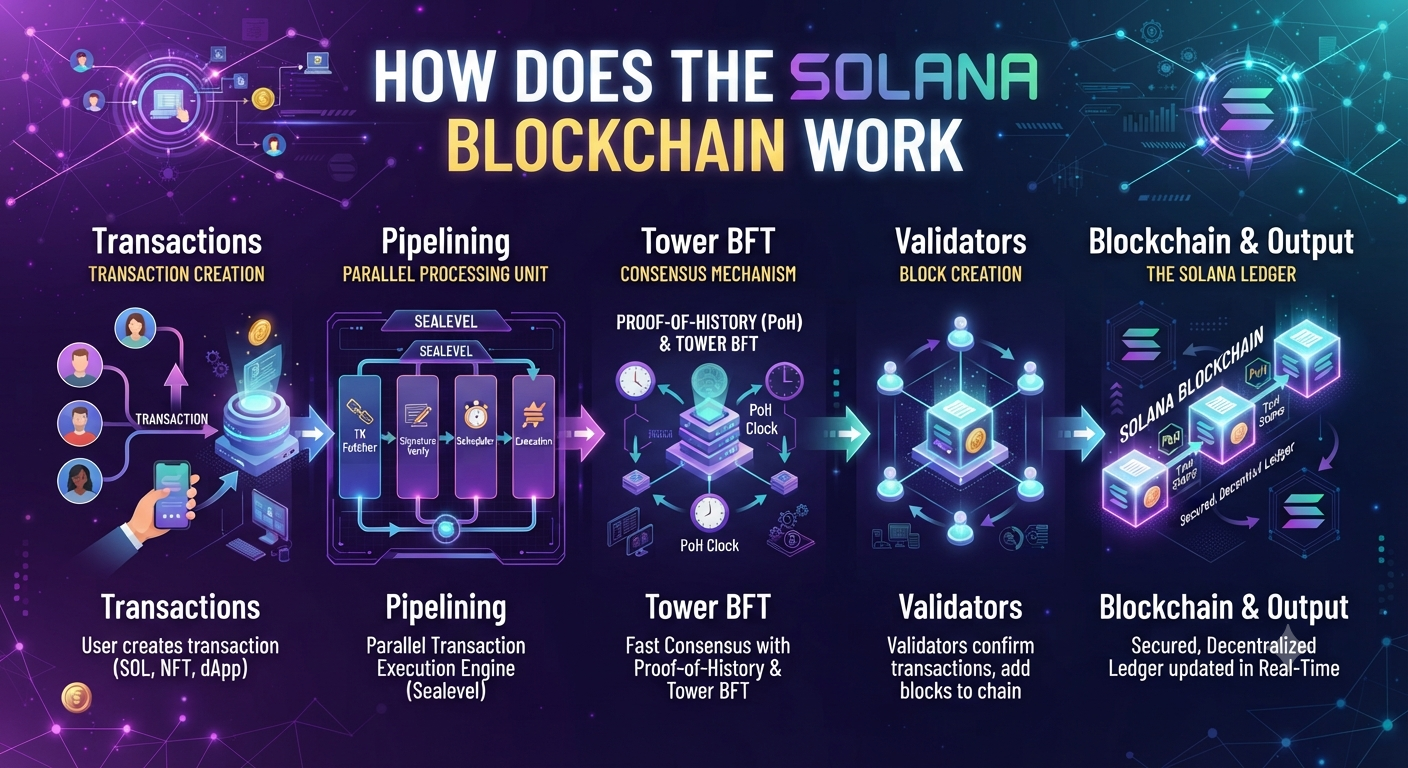
Solana works through a combination of transaction signing, validator processing, cryptographic ordering and Proof-of-Stake consensus.
When a user initiates a transaction, their wallet prepares the required instructions and signs the transaction using the appropriate private key. The signed transaction is submitted to the network, where it is forwarded towards the validator responsible for producing the next scheduled block.
The leader processes transactions and incorporates them into the network’s ordered transaction history. Other validators independently verify the relevant data and participate in consensus. Once the network reaches the required agreement, the transaction becomes part of the confirmed ledger.
Here is a simplified explanation of the process:
- A user initiates a transaction through a Solana wallet or application.
- The wallet creates the transaction instructions and signs them.
- The signed transaction is submitted to a Solana node.
- The transaction is forwarded to the appropriate leader.
- The leader processes and orders transactions.
- Validators verify the proposed transaction history and participate in consensus.
- The resulting state changes are recorded on the blockchain.
For example, imagine someone wants to send 2 SOL to another wallet.
The sender enters the recipient’s public address and amount. Their wallet signs the transaction and submits it to the network. Validators check the transaction, including whether the sender has sufficient funds and whether the signature is valid. After successful processing and confirmation, the recipient’s account reflects the transferred SOL.
The transaction is recorded in the public ledger, allowing it to be independently checked.
3. What Is Proof of History (PoH) in Solana?
Proof of History is one of the best-known features of Solana’s architecture.
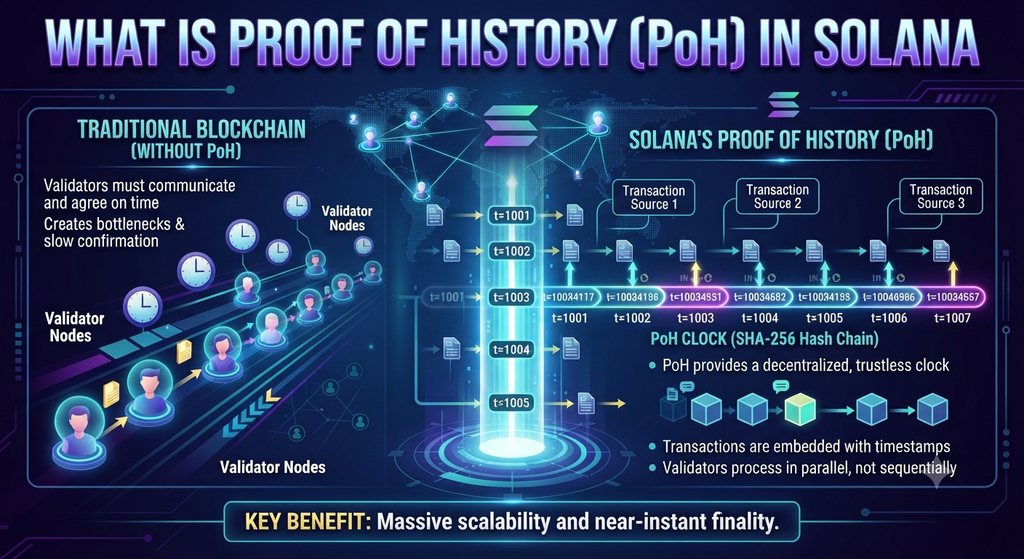
In traditional blockchain systems, validators need to coordinate the ordering of transactions. This coordination can introduce communication overhead, particularly when many transactions are being processed.
Solana uses Proof of History to provide a verifiable sequence of events. It acts like a cryptographic clock, helping the network establish the relative order in which events occurred.
PoH uses repeated cryptographic hashing. Each output becomes an input for the next calculation, creating a sequence that can be independently verified.
How Proof of History works
The process can be understood through these steps:
- A cryptographic hash is generated from an initial input.
- The output is used as the input for the next hashing operation.
- This process continues, creating a sequential chain of hashes.
- Data can be incorporated into the sequence to establish its position in the timeline.
- Other network participants can verify the sequence and its ordering.
Think of it as a digital record that helps demonstrate which event came before another.
Why is Proof of History important?
Proof of History helps reduce the amount of coordination required to establish transaction ordering. This supports Solana’s approach to processing transactions at high throughput.
However, one important distinction is that Proof of History is not the network’s consensus mechanism by itself. It provides a verifiable ordering mechanism, while Proof of Stake is used to help validators agree on the blockchain’s state.
4. What Is Proof of Stake (PoS) in Solana?
Proof of Stake is the consensus mechanism Solana uses to help secure its blockchain.
Instead of requiring miners to compete through energy-intensive computational work, Proof of Stake allows validators to participate by staking SOL.
Validators are responsible for processing transactions, producing blocks and voting on the validity of the network’s ledger.
SOL holders can also delegate their stake to validators. Delegation allows holders to support network security without personally operating validator infrastructure.
How Solana staking works
The process generally follows these steps:
- A SOL holder chooses a validator.
- The holder delegates SOL to that validator through a staking account.
- The delegated stake contributes to the validator’s total active stake.
- Validators participate in block production and consensus.
- Eligible staking participants may receive rewards according to network rules and validator performance.
Delegated SOL remains under the delegator’s control through the staking mechanism, but it is subject to activation and deactivation periods. It is not always immediately available for spending.
Why does Solana use Proof of Stake?
Proof of Stake helps the network:
- Coordinate agreement between validators.
- Discourage dishonest behaviour.
- Support decentralised block production.
- Reduce dependence on energy-intensive mining.
- Reward participants who help secure the network.
Staking is not risk-free. Rewards can change, validators may perform poorly, and users should understand the risks and applicable network rules before delegating SOL.
5. What Is the Role of Solana Validators?
Validators are essential participants in the Solana network. They operate specialised computers that communicate with other nodes, process transactions and participate in consensus.
Each validator maintains a view of the blockchain’s state and checks that proposed transactions follow network rules.
Solana uses a rotating leader schedule. A selected validator, known as the leader, is responsible for producing entries and processing transactions during its assigned slot.
Other validators receive the proposed data, verify it and participate in the voting process.
Main responsibilities of validators
Transaction verification: Validators check signatures, account balances, instructions and other transaction requirements.
Block production: The scheduled leader processes transactions and produces the entries for its assigned slot.
Consensus participation: Validators vote on the proposed ledger history according to Solana’s consensus rules.
Network security: Validators help prevent invalid transactions and conflicting changes from becoming part of the accepted ledger.
Ledger maintenance: They maintain and update the blockchain state as new transactions are processed.
Validators can receive rewards for participating in the network. Their performance and reliability matter to people who delegate SOL to them.
6. How Are Transactions Processed on Solana?
Solana transactions are the basic units used to request changes to the blockchain.
A transaction may contain one or more instructions. Each instruction tells a particular on-chain program what operation to perform and identifies the accounts involved.
For example, a simple SOL transfer uses an instruction that requests the System Program to move SOL from one account to another.
Step-by-step transaction processing
Step 1: Transaction creation
A user selects an operation in a wallet or decentralised application. The application prepares the required transaction instructions.
Step 2: Digital signature
The wallet signs the transaction using the sender’s private key. This proves that the transaction was authorised by the appropriate account.
Step 3: Network submission
The signed transaction is sent to a Solana node, usually through an RPC endpoint. The node forwards it towards the relevant leader.
Step 4: Transaction execution
The leader processes the transaction according to the instructions and the current blockchain state. The runtime checks whether the transaction is valid and whether it can be executed successfully.
Step 5: Validator verification
Other validators receive the relevant transaction data and verify the proposed ledger entries. They participate in the network’s consensus process.
Step 6: Confirmation
The transaction progresses through the network’s confirmation stages. Wallets and applications can use these statuses to determine whether it has been processed and how much confidence to place in its finality.
Does Solana have a traditional mempool?
Solana’s transaction-forwarding architecture differs from the traditional public mempool model used by some other blockchains. Transactions are forwarded towards upcoming leaders rather than being collected in one globally shared public mempool.
This design is part of Solana’s approach to reducing communication overhead and supporting high-throughput transaction processing.
7. What Are Solana Accounts and Programs?
Solana uses an account-based architecture to store information and execute operations.
Understanding accounts and programs is important because almost every activity on Solana involves them.
Solana accounts
An account is an on-chain data structure identified by a public address. Accounts can hold SOL, token information, program data or other information required by applications.
A Solana account includes fields such as:
- Lamports: The account’s SOL balance, measured in the smallest SOL unit.
- Data: Information stored in the account.
- Owner: The program that controls the account’s data.
- Executable status: Whether the account contains an executable program.
- Rent-related information: Account metadata associated with the network’s storage rules.
One SOL equals 1 billion lamports.
Solana programs
Programs are the on-chain instructions and logic that applications use to perform operations. They are often compared with smart contracts on other blockchains.
For example, a decentralised exchange may use programs to:
- Exchange one token for another.
- Calculate the amount received from a swap.
- Manage liquidity pools.
- Apply trading conditions.
- Update account balances.
Solana programs are generally stateless: the application state is stored in separate accounts that programs read or modify when processing instructions.
This separation is an important part of Solana’s architecture.
8. What Are Smart Contracts on Solana?
Smart contracts are computer programs that execute predefined instructions when called by users or other programs.
On Solana, these are commonly called on-chain programs.
Developers use them to build decentralised applications without requiring a central organisation to manually process every operation.
For example, a lending application can use a program to manage deposits, calculate borrowing requirements and process repayments according to its programmed rules.
Common applications of Solana smart contracts
Decentralised finance: Users can lend, borrow, trade and provide liquidity through blockchain-based applications.
NFT marketplaces: Programs can support the creation, transfer and trading of digital collectibles.
Gaming: Developers can use on-chain programs to manage digital assets and selected game-related operations.
Token creation: Projects can create and manage tokens using Solana’s token programs.
Decentralised exchanges: Trading applications can execute token swaps without relying on a traditional centralised exchange.
Smart contracts also introduce risks. Programming errors, poor security practices and malicious application design can result in financial losses. Users should verify applications before connecting wallets or approving transactions.
9. How Does Solana Handle Tokens?
Solana supports digital assets through token programs.
The two commonly discussed token standards are:
- SPL Token: The established Solana token program used to create and manage fungible tokens and other token-related assets.
- Token-2022: An extension of the token ecosystem that supports additional features through extensions, depending on how a token is configured.
A token on Solana is not necessarily a separate blockchain. It is an asset represented and managed through accounts and programs on the Solana network.
For example, a project can issue its own token using Solana’s token infrastructure. Users can then hold, transfer and trade that token through compatible wallets and applications.
Solana also supports NFTs, which represent unique digital assets. Their ownership and associated metadata can be managed using on-chain programs and related storage systems.
10. What Is SOL and Why Is It Important?
SOL is the native cryptocurrency of the Solana blockchain. It plays an important role in the network’s operation.
SOL is not simply an investment asset. It also provides the economic functionality required to use the blockchain.
Main uses of SOL
Transaction fees: Users pay SOL-denominated fees when submitting transactions.
Staking: SOL holders can delegate tokens to validators to participate indirectly in network security.
Validator participation: Validators use stake to participate in the network’s Proof-of-Stake system.
Application activity: SOL can be used to interact with decentralised applications and pay for on-chain operations.
Transfers and payments: Users can send SOL between compatible wallets.
Understanding Solana transaction fees
Solana charges a base transaction fee, with an optional priority fee that users can include to improve transaction prioritisation.
The base fee is calculated according to the number of transaction signatures. Priority fees depend on the requested compute budget and the price offered per compute unit.
Some operations also involve account storage requirements. These should not be confused with ordinary transaction fees.
Although Solana is designed to support relatively low transaction costs, fees can vary depending on network conditions and the type of activity being performed.
11. Why Is Solana Known for Fast Transactions?
Solana is designed to process a large number of transactions through a combination of architectural features.
Its approach includes Proof of History, parallel transaction execution, a leader-based transaction-forwarding system and other performance optimisations.
Important technologies supporting Solana’s performance
Proof of History: Helps establish a verifiable order of events.
Parallel execution: Transactions that do not conflict over writable account data can be processed concurrently.
Sealevel runtime: Solana’s execution environment supports parallel processing of transactions when their account dependencies allow it.
Turbine: A block-propagation protocol designed to distribute data efficiently across the validator network.
Gulf Stream: A transaction-forwarding approach that sends transactions towards upcoming leaders.
These technologies contribute to Solana’s performance goals. However, advertised theoretical throughput should not be confused with the number of transactions the network consistently processes under real-world conditions.
Actual performance depends on network demand, transaction complexity, validator hardware, network conditions and application design.
12. Solana vs Ethereum: How Are They Different?
Solana and Ethereum are two major blockchain ecosystems that support smart contracts, tokens and decentralised applications. However, they use different technical architectures.
| Feature | Solana | Ethereum |
|---|---|---|
| Blockchain type | Layer-1 | Layer-1 |
| Consensus | Proof of Stake with Proof of History-based ordering | Proof of Stake |
| Smart contracts | On-chain programs | Smart contracts |
| Execution model | Supports parallel execution based on account dependencies | Ethereum mainnet executes transactions sequentially |
| Native token | SOL | ETH |
| Transaction fees | Paid in SOL | Paid in ETH |
| Token ecosystem | SPL Token and Token-2022 | ERC-20 and other standards |
| Main focus | High-throughput blockchain applications | General-purpose decentralised computing and settlement |
13. What Are the Advantages of the Solana Blockchain?
Solana offers several features that make it attractive to users and developers.
1. High transaction throughput
Solana’s architecture is designed to process a high volume of transactions. This can support applications that require frequent on-chain activity.
2. Relatively low transaction fees
Many routine transactions on Solana cost relatively little compared with activity on some congested blockchain networks. This can make smaller transfers and application interactions more practical.
3. Support for decentralised applications
Developers can create decentralised exchanges, lending platforms, games, NFT marketplaces and other applications using Solana programs.
4. Proof-of-Stake security
The network uses validators and delegated stake to support consensus without relying on traditional Proof-of-Work mining.
5. Active developer ecosystem
Solana provides documentation, development tools and infrastructure that developers can use to build blockchain applications.
6. Native digital asset support
The network supports SOL, fungible tokens, NFTs and other digital asset use cases.
14. What Are the Risks and Limitations of Solana?
Despite its technical advantages, Solana is not free from risks.
Anyone using the network should understand its limitations before transferring funds or interacting with applications.
Network outages and disruptions: Blockchain networks can experience performance problems or interruptions. Users should not assume that services will always be available.
Validator requirements: Operating a competitive validator can require substantial hardware, bandwidth and technical knowledge. These requirements may affect who can participate directly.
Smart contract vulnerabilities: Bugs or security weaknesses in applications can lead to lost funds or unauthorised transactions.
Wallet security: If someone gains access to a user’s private key or recovery phrase, they may be able to control the associated assets.
Token scams: Fraudulent tokens, fake websites and impersonation schemes can target Solana users.
Market volatility: SOL and other tokens can experience significant price movements. Network usage does not guarantee that a token’s market value will increase.
Centralisation concerns: Validator distribution, stake concentration, infrastructure requirements and dependence on service providers are important factors when evaluating decentralisation.
Users should research applications, verify wallet addresses and avoid signing transactions they do not understand.
15. What Happens When You Send SOL?
Consider a practical example.
Suppose Alice wants to send 1 SOL to Bob.
The process works as follows:
- Alice opens her Solana wallet.
- She enters Bob’s public wallet address.
- She selects 1 SOL as the transfer amount.
- Her wallet prepares the transaction and includes the required network instructions.
- Alice reviews and signs the transaction using her wallet.
- The signed transaction is submitted to a Solana node.
- The network forwards it to the relevant leader for processing.
- Validators verify the transaction and participate in consensus.
- Once confirmed, the ledger reflects the transfer.
- Bob can see the received SOL in his wallet.
The transaction also includes a network fee, which is generally paid by the sender.
Alice should always verify Bob’s wallet address before confirming the transfer. Blockchain transactions are generally difficult or impossible to reverse once finalised.
16. What Is the Future of the Solana Blockchain?
Solana’s future development will depend on its ability to improve performance, maintain network reliability, strengthen security and support useful applications.
Several areas are particularly relevant:
Decentralised finance: Lending, trading, payments and other financial applications may continue to develop across the Solana ecosystem.
Stablecoin payments: Stablecoins can support transfers and digital payments where users want to reduce exposure to the price volatility of cryptocurrencies such as SOL.
Tokenisation: Blockchain-based representations of financial and other real-world assets may create additional use cases.
Gaming and digital ownership: Solana programs can support blockchain games and digital asset marketplaces.
Developer infrastructure: Improvements to development tools, network clients and validator technology may help expand the ecosystem.
Network resilience: Reliability, decentralisation and security will remain important measures of the network’s long-term progress.
The success of Solana will depend not only on transaction speed but also on whether people and businesses continue to find practical reasons to use its applications.
Final Thoughts
The Solana blockchain combines Proof of Stake, Proof of History and a high-performance execution architecture to support digital transactions and decentralised applications. Its account-based system, on-chain programs and native SOL token allow developers and users to interact with a wide range of blockchain services.
Understanding how Solana works helps beginners look beyond the SOL price and recognise the technology that supports the ecosystem. At the same time, network performance, decentralisation, wallet security and application risks should all be considered before using the platform.
As blockchain technology develops, Solana’s long-term relevance will depend on its ability to deliver reliable infrastructure and practical applications that people genuinely need.
Enjoying Cryptorevery?
If you find our crypto insights and market updates helpful, add Cryptorevery as a Preferred Source on Google to see more of our latest content.
Found this article useful?
If this content helped you, you may support the developer by contributing the cost of a coffee.
Pay $5

