





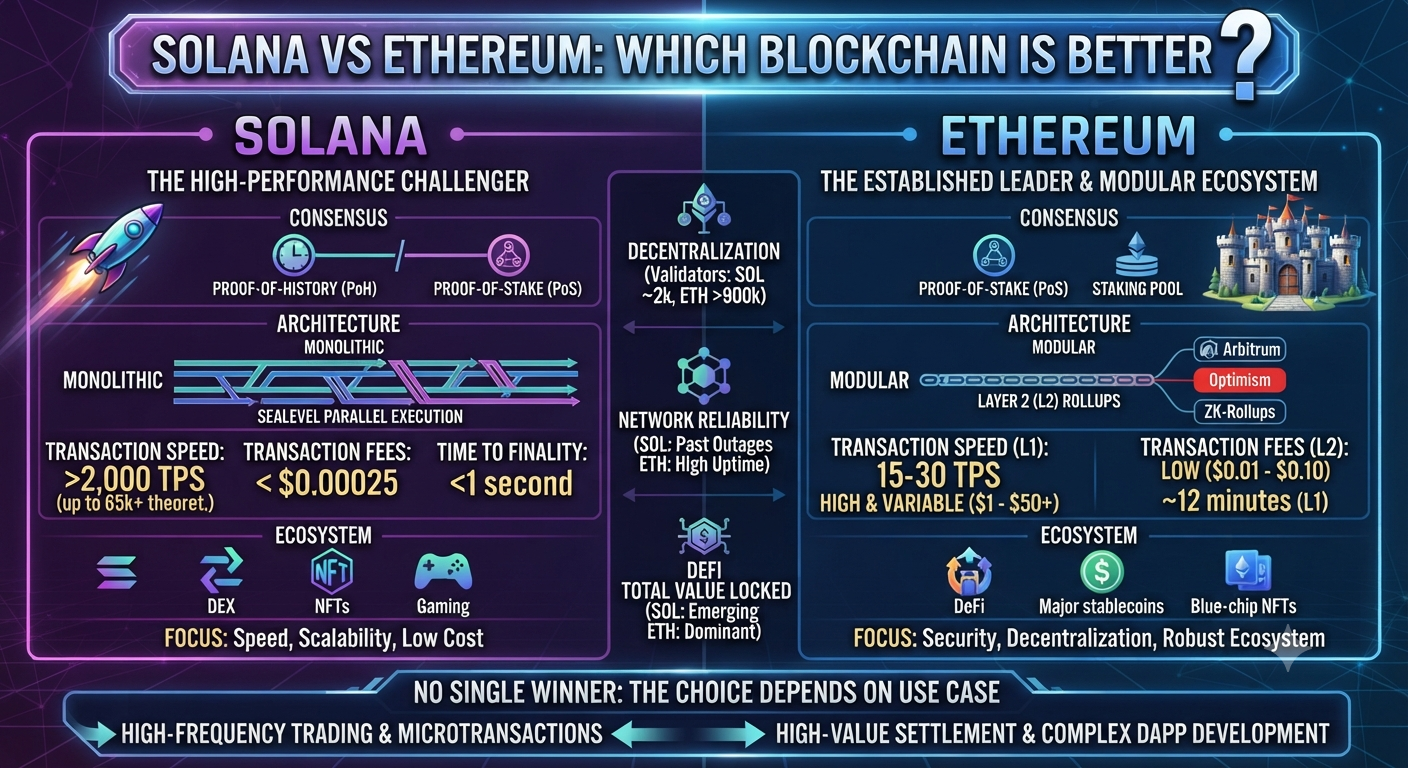
Blockchain technology has changed the way people think about digital payments, financial services, online applications and digital ownership. Among the many blockchain networks available today, Solana and Ethereum are two of the most widely discussed ecosystems.
Both platforms allow developers to build decentralised applications, create digital tokens, operate decentralised finance (DeFi) services and support non-fungible tokens (NFTs). However, their technical designs, transaction processing methods, developer environments and approaches to scalability are different.
Solana is known for its focus on high transaction throughput and low-cost activity on a single Layer-1 network. Ethereum, on the other hand, has established itself as a major smart contract platform with a broad developer ecosystem and a scaling strategy that includes Layer-2 networks.
So, Solana vs Ethereum: which blockchain is better?
The answer depends on what you want to do. If you prioritise fast, inexpensive transactions on a single blockchain, Solana may be attractive. If you value Ethereum’s established smart contract ecosystem, its network of Layer-2 solutions and its broad infrastructure, Ethereum may be a better fit.
This guide compares both networks to help beginners understand their differences and make informed decisions.
1. What Is Solana?
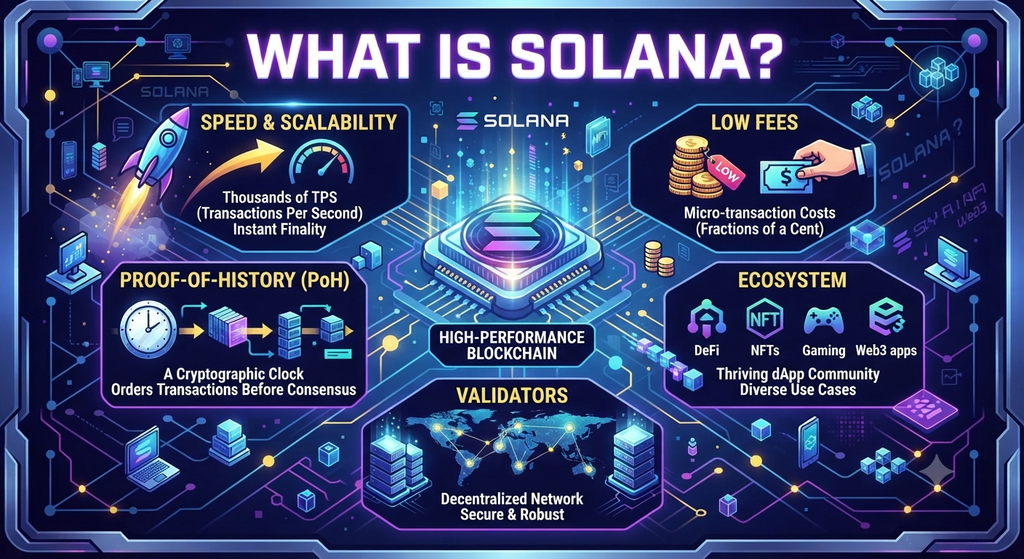
Solana is a public Layer-1 blockchain designed to support digital payments, smart contracts, tokens and decentralised applications. It uses a Proof-of-Stake-based consensus system and a high-performance architecture intended to process transactions efficiently.
Its native cryptocurrency is SOL, which is used to pay network fees, participate in staking and interact with applications.
One of Solana’s best-known technical innovations is Proof of History (PoH), a cryptographic mechanism originally used to establish a verifiable ordering of events. Solana’s consensus architecture has evolved, so PoH should not be treated as the entire consensus mechanism.
Main features of Solana
- High-throughput transaction processing.
- Relatively low fees for many routine transactions.
- Proof-of-Stake-based validator participation.
- Support for fungible tokens and NFTs.
- Smart contracts, commonly called on-chain programs.
- Parallel transaction execution when account dependencies allow it.
- An ecosystem of decentralised exchanges, payment applications and DeFi platforms.
Solana is particularly relevant for applications that involve frequent transactions, such as token swaps, trading, payments and consumer-facing blockchain services.
2. What Is Ethereum?
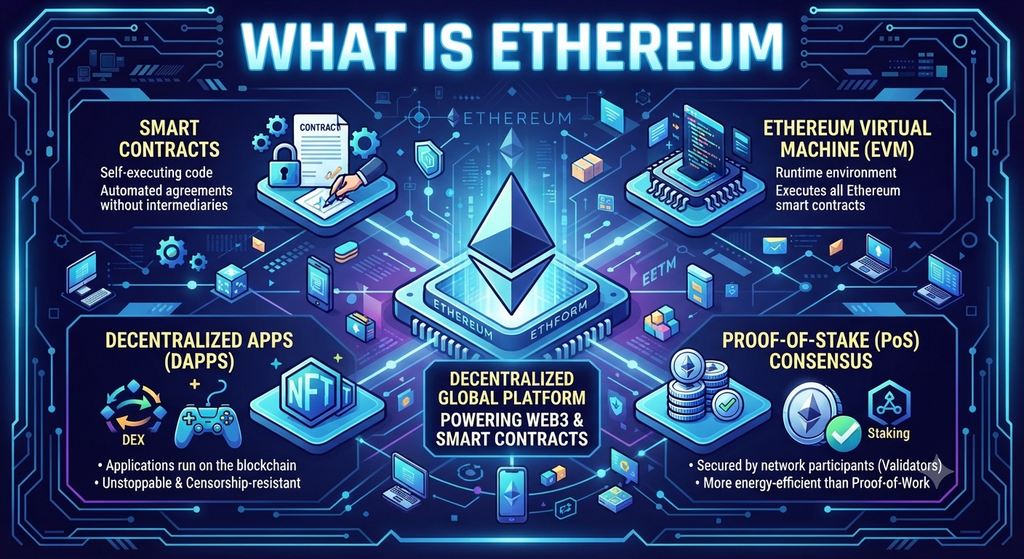
Ethereum is a decentralised, open-source blockchain platform that allows developers to create smart contracts and decentralised applications.
It introduced a general-purpose blockchain environment in which developers can build applications that operate according to programmed rules without relying entirely on centralised intermediaries.
Ethereum’s native cryptocurrency is Ether (ETH). Users pay transaction fees in ETH, while validators stake ETH to participate in network consensus.
Ethereum originally used Proof of Work, but it transitioned to Proof of Stake in September 2022 through an upgrade known as The Merge.
Main features of Ethereum
- Proof-of-Stake consensus.
- Smart contracts and the Ethereum Virtual Machine (EVM).
- Support for tokens through standards such as ERC-20.
- NFT standards such as ERC-721 and ERC-1155.
- A large ecosystem of decentralised applications.
- Layer-2 scaling networks such as Arbitrum, Optimism and Base.
- Broad developer tooling and infrastructure.
Ethereum is widely used for decentralised finance, stablecoins, tokenisation, NFTs, decentralised exchanges and other blockchain-based services.
3. Solana vs Ethereum: Quick Comparison
The following table highlights the main differences between the two networks.
| Feature | Solana | Ethereum |
|---|---|---|
| Blockchain type | Layer-1 | Layer-1 |
| Native cryptocurrency | SOL | ETH |
| Consensus | Proof of Stake with Solana-specific consensus architecture | Proof of Stake using Gasper |
| Transaction processing | Designed for high throughput on Layer-1 | Mainnet execution with scaling through Layer-2 networks |
| Smart contracts | On-chain programs | Smart contracts |
| Execution environment | Solana Virtual Machine (SVM) | Ethereum Virtual Machine (EVM) |
| Common development languages | Rust and related tooling | Solidity and Vyper |
| Token standards | SPL Token and Token-2022 | ERC-20 and other ERC standards |
| Transaction fees | Generally low for routine activity | Can vary significantly on mainnet; Layer-2 fees may be lower |
| Scalability approach | Optimises the Layer-1 architecture | Uses Layer-1 improvements and Layer-2 rollups |
| Staking | SOL staking | ETH staking |
| Popular applications | DeFi, trading, payments, NFTs and consumer apps | DeFi, stablecoins, tokenisation, NFTs and decentralised applications |
4. Solana vs Ethereum: Consensus Mechanism
Consensus is the process through which blockchain validators agree on the accepted transaction history and network state.
Both Solana and Ethereum use Proof of Stake, but their consensus architectures are not identical.
How Solana consensus works
Solana uses a Proof-of-Stake-based system in which validators participate in block production and consensus according to their stake and the network’s protocol rules.
Solana originally combined Tower BFT with Proof of History. PoH helped establish a verifiable sequence of events, while Tower BFT supported validator agreement.
Solana’s consensus design has continued to evolve. Its newer Alpenglow architecture introduces Votor for voting and finality, replacing the earlier Tower BFT voting layer as the upgrade is deployed. Therefore, older explanations that describe PoH and Tower BFT as the complete current consensus system may be outdated.
How Ethereum consensus works
Ethereum uses Proof of Stake through its consensus protocol, commonly known as Gasper.
Validators deposit ETH into the staking system and participate in proposing and attesting to blocks. The network uses Casper FFG for finality and LMD-GHOST for fork choice.
Ethereum organises consensus into slots and epochs. Validators vote on the chain’s state, and blocks become final when the required protocol conditions are met.
Which consensus mechanism is better?
There is no universal winner.
Solana’s architecture focuses on efficient transaction processing and rapid confirmation. Ethereum’s consensus system focuses on stake-based agreement, economic finality and a broad validator infrastructure.
The best choice depends on whether an application prioritises transaction latency, settlement requirements, validator participation or other security considerations.
5. Solana vs Ethereum: Transaction Speed
Transaction speed is one of the most discussed differences between Solana and Ethereum.
Solana was designed to process a high volume of transactions on its base layer. Its architecture includes parallel execution, efficient transaction forwarding and specialised data-propagation mechanisms.
Ethereum’s base layer uses a different execution model. Its scalability strategy increasingly relies on Layer-2 networks that process transactions separately and use Ethereum for settlement and data availability, depending on the rollup design.
Solana transaction processing
Solana transactions declare the accounts they need to read or modify. This information allows the runtime to identify transactions that do not conflict with one another and execute them in parallel.
For example, if two transactions update completely separate accounts, they may be processed simultaneously.
This helps Solana use available computing resources more efficiently.
Ethereum transaction processing
Ethereum’s mainnet processes transactions through the Ethereum Virtual Machine. Transactions update the network’s state according to their execution order.
Layer-2 rollups improve the overall Ethereum ecosystem’s capacity by processing transactions outside the mainnet and posting relevant data or proofs back to Ethereum.
Which blockchain is faster?
Solana is designed for high transaction throughput on its Layer-1 network, while Ethereum’s broader scaling capacity includes its Layer-2 ecosystem.
A fair comparison should distinguish between Ethereum mainnet and Ethereum plus its Layer-2 networks. It should also consider real-world throughput, transaction complexity, network congestion and finality rather than relying only on advertised maximum transaction speeds.
6. Solana vs Ethereum: Transaction Fees
Transaction fees matter to users who regularly transfer tokens, trade cryptocurrencies or interact with decentralised applications.
Solana is generally associated with low fees for routine transactions. Ethereum mainnet fees can be higher during periods of heavy demand, although Ethereum Layer-2 networks can offer less expensive transactions.
Solana fees
Solana charges a base fee, with an optional priority fee that can help prioritise transactions.
The base fee is denominated in SOL, and its smallest unit is the lamport. One SOL equals one billion lamports.
Users may also encounter costs associated with account creation or storage-related requirements.
Ethereum fees
Ethereum uses a gas system.
Every operation requires a certain amount of gas, depending on the computational work and resources involved. The final fee depends on the gas consumed and the effective gas price.
Ethereum’s fee model includes a base fee and an optional priority fee. The base fee changes according to network demand.
Layer-2 networks have their own fee structures, which may include execution costs and charges associated with posting data to Ethereum.
Which blockchain is cheaper?
For many ordinary transactions, Solana is typically less expensive than Ethereum mainnet.
However, Ethereum Layer-2 networks can significantly reduce transaction costs. Users should compare the actual fee on the specific network they plan to use instead of assuming that every Ethereum transaction is expensive.
7. Solana vs Ethereum: Smart Contracts
Smart contracts are programs stored and executed on a blockchain. They allow developers to create applications that perform operations according to predefined rules.
Both Solana and Ethereum support smart contracts, but their development environments differ.
Smart contracts on Solana
Solana smart contracts are generally called on-chain programs.
Developers commonly use Rust and frameworks such as Anchor to create programs. Solana’s account-based architecture separates program logic from the accounts that store application data.
This design supports parallel execution when transactions do not conflict over writable accounts.
Smart contracts on Ethereum
Ethereum smart contracts run inside the Ethereum Virtual Machine.
Solidity is the most widely used language for Ethereum smart contract development, while Vyper is another option.
Ethereum contracts can manage tokens, lending protocols, decentralised exchanges, NFTs and other applications.
Which platform is better for smart contracts?
Ethereum has an established smart contract development ecosystem, extensive documentation and a large collection of existing applications.
Solana offers a different execution environment that is attractive to developers building applications requiring frequent transactions and parallel processing.
The choice depends on the development team’s technical experience, application requirements, security needs and ecosystem preferences.
8. Solana vs Ethereum: DeFi Ecosystem
Decentralised finance allows people to access financial services through blockchain applications rather than depending entirely on traditional financial institutions.
Both Solana and Ethereum support DeFi, including token swaps, lending, borrowing and liquidity provision.
DeFi on Solana
Solana supports a range of DeFi applications, including:
- Decentralised exchanges.
- Automated market makers.
- Lending and borrowing platforms.
- Liquid staking services.
- Token trading applications.
- Liquidity management tools.
Its low-cost transaction environment can be useful for users who interact with DeFi applications frequently.
DeFi on Ethereum
Ethereum has a long-established DeFi ecosystem with applications supporting:
- Decentralised exchanges.
- Lending and borrowing.
- Stablecoin services.
- Liquid staking.
- Yield management.
- Derivatives and other financial products.
Ethereum’s Layer-2 ecosystem also provides additional environments for DeFi applications.
Which blockchain is better for DeFi?
Ethereum has a mature DeFi ecosystem and a broad network of applications, liquidity providers and infrastructure.
Solana is attractive for applications that benefit from fast execution and low transaction costs.
Users should evaluate liquidity, smart contract audits, application history, token risks and withdrawal conditions before depositing funds on either network.
9. Solana vs Ethereum: NFTs and Digital Assets
Non-fungible tokens represent unique digital assets. They can be used for digital collectibles, artwork, gaming items, memberships and other forms of digital ownership.
Both Solana and Ethereum support NFTs, but they use different technical standards and ecosystems.
NFTs on Solana
Solana supports NFTs through its token and account infrastructure. Its relatively low transaction costs can make minting and transferring digital assets more accessible for some projects.
NFTs on Ethereum
Ethereum supports NFTs through established standards such as ERC-721 and ERC-1155.
Its NFT ecosystem has a long history and includes marketplaces, digital art projects, gaming assets and tokenised memberships.
Which is better for NFTs?
Solana may be attractive for projects that require frequent and inexpensive NFT transactions.
Ethereum may be preferred by projects that value its established NFT infrastructure, developer ecosystem and marketplace integrations.
The right choice depends on the audience, marketplace support, transaction costs and long-term project requirements.
10. Solana vs Ethereum: Scalability
Scalability refers to a blockchain’s ability to handle increasing transaction demand without unacceptable delays, costs or performance problems.
Solana and Ethereum approach scalability differently.
Solana’s scalability approach
Solana focuses on improving the performance of its Layer-1 network.
Its design includes:
- Parallel transaction execution.
- Efficient transaction forwarding.
- High-performance validator software.
- Optimised block-data propagation.
- Improvements to its runtime and network infrastructure.
This approach aims to support many applications on a shared blockchain environment.
Ethereum’s scalability approach
Ethereum follows a rollup-centric scaling strategy.
Layer-2 networks process transactions outside the Ethereum mainnet and use Ethereum for settlement and, depending on the rollup, data availability.
Examples include:
- Arbitrum.
- Optimism.
- Base.
- zkSync.
These networks help expand transaction capacity while maintaining a connection to Ethereum’s security and settlement infrastructure.
Which blockchain is more scalable?
Solana focuses on scaling its base layer, while Ethereum expands its ecosystem through Layer-2 networks and mainnet improvements.
Neither approach is automatically superior. Solana offers a more unified Layer-1 experience, whereas Ethereum provides a broader network of specialised execution environments.
11. Solana vs Ethereum: Security and Decentralisation
Security and decentralisation are essential when choosing a blockchain.
A network may offer low fees and fast transactions, but users also need to understand how it protects funds, handles failures and distributes control among participants.
Solana security
Solana uses cryptographic signatures, validator participation and stake-based consensus to protect its network.
However, users should consider:
- Validator distribution and stake concentration.
- Hardware and bandwidth requirements.
- Network reliability.
- Smart contract vulnerabilities.
- Wallet and private-key security.
- Risks associated with third-party applications.
Solana has experienced network disruptions in its history, making reliability and resilience important areas to evaluate.
Ethereum security
Ethereum uses Proof of Stake and a large validator ecosystem to secure its consensus process.
Its security model is supported by:
- Stake-based validator participation.
- Cryptographic verification.
- Economic penalties for certain validator misconduct.
- Client diversity.
- Extensive smart contract development and security research.
Ethereum is not risk-free. Smart contract vulnerabilities, wallet theft, bridge exploits and application-level failures can still cause financial losses.
Which blockchain is more decentralised?
Decentralisation cannot be measured by a single number.
It involves validator distribution, infrastructure requirements, client diversity, governance, network participation and the concentration of economic influence.
Ethereum and Solana have different operating requirements and network structures. Users should examine current validator and staking data rather than relying on broad claims that one network is completely decentralised and the other is not.
12. Solana vs Ethereum: Developer Ecosystem
Developers are responsible for creating the applications that make a blockchain useful.
Both Solana and Ethereum provide software development tools, documentation and infrastructure, but their programming environments differ.
Solana developer ecosystem
Solana development commonly involves:
- Rust programming language.
- Anchor framework.
- Solana Software Development Kit (SDK).
- Solana Virtual Machine.
- RPC providers and developer infrastructure.
- Token and NFT programs.
Developers familiar with systems programming may find Solana’s environment appealing, although learning its account model and transaction structure requires preparation.
Ethereum developer ecosystem
Ethereum development commonly involves:
- Solidity programming language.
- Vyper.
- Ethereum Virtual Machine.
- Hardhat and Foundry development tools.
- Web3 libraries.
- EVM-compatible infrastructure.
Ethereum’s established tooling and EVM compatibility make it an important platform for developers building decentralised applications.
Which is better for developers?
Ethereum may be a practical choice for developers who want to work with established EVM tools and existing smart contract standards.
Solana may be suitable for teams that prefer its execution model and want to build applications around its high-throughput architecture.
Developer experience, security tools, user demand and ecosystem support should all influence the decision.
13. Solana vs Ethereum: Popular Use Cases
Both blockchains support a wide range of applications, but some use cases may benefit more from one network’s architecture.
| Use Case | Solana | Ethereum |
|---|---|---|
| Token transfers | Suitable for low-cost, frequent transfers | Supported on mainnet and Layer-2 networks |
| DeFi | Trading, swaps, lending and liquidity services | Large established DeFi ecosystem |
| NFTs | Digital collectibles and gaming assets | Established NFT standards and marketplaces |
| Stablecoins | Supports stablecoin payments and transfers | Major stablecoin settlement and application ecosystem |
| Gaming | Suitable for frequent in-game asset interactions | Supports gaming applications and Layer-2 environments |
| Smart contracts | Solana on-chain programs | EVM smart contracts |
| Tokenisation | Supports tokenised assets | Broad tokenisation infrastructure and standards |
| Developer tools | Rust, Anchor and SVM tools | Solidity, Vyper and EVM tools |
16. Solana vs Ethereum: Which Is Better for Beginners?
Beginners should choose a blockchain based on what they want to do rather than simply selecting the network with the lowest fees or highest advertised transaction speed.
Solana may suit beginners who:
- Want to make frequent, low-cost transactions.
- Are interested in Solana-based tokens and applications.
- Want to explore fast-moving DeFi and trading applications.
- Prefer using applications within a single Layer-1 environment.
Ethereum may suit beginners who:
- Want to learn about established smart contract applications.
- Are interested in Ethereum’s DeFi and NFT ecosystem.
- Want access to EVM-compatible applications.
- Are willing to explore Layer-2 networks to reduce transaction costs.
Regardless of the network, beginners should start with small amounts, protect their recovery phrases and verify application websites before connecting wallets.
17. Solana vs Ethereum: Which Is Better for Long-Term Investment?
Choosing a blockchain for technology use is different from deciding whether to buy its cryptocurrency.
SOL and ETH are volatile digital assets. Their prices can change significantly because of market demand, economic conditions, regulations, network activity and investor sentiment.
Factors to consider before investing in SOL
- Growth in Solana application usage.
- Network reliability and validator participation.
- DeFi and stablecoin activity.
- Developer adoption.
- Token supply and staking economics.
- Competition from other blockchain networks.
Factors to consider before investing in ETH
- Ethereum network usage.
- Layer-2 ecosystem growth.
- DeFi and stablecoin adoption.
- Validator participation and staking economics.
- Demand for blockspace and transaction settlement.
- Competition from other smart contract platforms.
Is SOL a better investment than ETH?
There is no guaranteed answer.
SOL and ETH represent different blockchain ecosystems and have different economic models. A strong technology ecosystem does not automatically translate into a higher token price.
Investors should research token supply, valuation, liquidity, risks and personal financial circumstances before making investment decisions. This comparison is educational and should not be treated as financial advice.
18. Final Verdict: Solana vs Ethereum – Which Blockchain Is Better?
Solana and Ethereum are both important blockchain platforms, but they focus on different technical priorities.
Solana is a strong option for applications that benefit from high transaction throughput, low fees and a unified Layer-1 environment. Its architecture is particularly relevant to frequent trading, payments and consumer-facing applications.
Ethereum is a strong option for developers and users who value its established smart contract ecosystem, broad infrastructure and rollup-based scaling approach. Its long-standing developer community and extensive application network make it an important part of the blockchain industry.
Rather than declaring one blockchain the winner, it is more useful to match the network to the intended purpose.
For everyday transactions and applications that benefit from low-cost Layer-1 activity, Solana may be the more convenient choice. For established smart contract infrastructure and access to a broad network of Layer-2 applications, Ethereum may be more suitable.
Final Thoughts:
The Solana vs Ethereum comparison shows that blockchain performance is about more than speed and transaction fees. Security, decentralisation, developer tools, liquidity, application support and long-term reliability are equally important.
Solana focuses on high-throughput activity within its Layer-1 architecture, while Ethereum combines its established mainnet with a growing Layer-2 ecosystem. Both continue to develop and offer useful infrastructure for the decentralised internet.
For beginners, the best approach is to understand how each network works, compare the applications available and consider the risks before transferring or investing in digital assets.
Enjoying Cryptorevery?
If you find our crypto insights and market updates helpful, add Cryptorevery as a Preferred Source on Google to see more of our latest content.
Found this article useful?
If this content helped you, you may support the developer by contributing the cost of a coffee.
Pay $5

